
Primary Antibody Matched Pairs

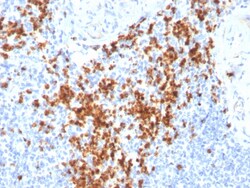
Biotium Granzyme B (NK/T-Cell Lymphoma Marker)(GZMB/3014), 1mg/mL
Granzyme B is a member of the granule serine protease family stored specifically in NK cells or cytotoxic T cells. Cytolytic T lymphocytes (CTL) and natural killer (NK) cells share the ability to recognize, bind, and lyse specific target cells. They are thought to protect their host by lysing cells bearing on their surface 'nonself' antigens, usually peptides or proteins resulting from infection by intracellular pathogens. Granzyme B is crucial for the rapid induction of target cell apoptosis by CTLs in the cell-mediated immune response. Granzyme B is useful as a marker in the identification of NK/T-cell lymphomas. High percentages of cytotoxic T-cells have been shown to be an unfavorable prognostic indicator in Hodgkin's Disease. Primary antibodies are available purified, or with a selection of fluorescent CF Dyes and other labels. CF Dyes offer exceptional brightness and photostability. Note: Conjugates of blue fluorescent dyes like CF405S and CF405M are not recommende

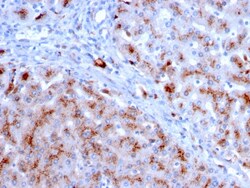
Biotium Cathepsin D (Tumor Marker)(CTSD/3083), CF594 conjugate, 0.1mg/mL
Cathepsin D is a ubiquitously expressed lysosomal aspartyl protease involved in the normal degradation of proteins. It is synthesized as an inactive 43 kDa preprocathepsin D that is cleaved and glycosylated to form a 46 kDa procathepsin D and then further cleaved to produce 28 kDa and 15 kDa subunits (heavy and light chains, respectively). Cathepsin D exhibits pepsin-like activity and plays a role in protein turnover and in the proteolytic activation of hormones and growth factors. Mutations in this gene play a causal role in neuronal ceroid lipofuscinosis-10 and may be involved in the pathogenesis of several other diseases, including breast cancer and possibly Alzheimer's disease. Primary antibodies are available purified, or with a selection of fluorescent CF Dyes and other labels. CF Dyes offer exceptional brightness and photostability. Note: Conjugates of blue fluorescent dyes like CF405S and CF405M are not recommended for detecting low abundance targets, because blu
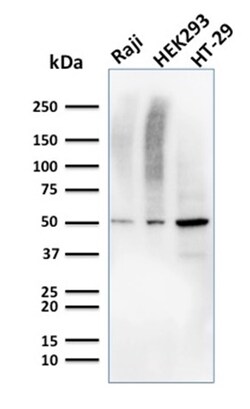
Biotium MMP3 (Marker of Metastasis and Rheumatoid Arthritis)(MMP3/2655), CF740 conjugate, 0.1mg/mL
The matrix metalloproteinases (MMP) are a family of peptidase enzymes responsible for the degradation of extracellular matrix components, including collagen, gelatin, fibronectin, laminin and proteoglycan. Transcription of MMP genes is differentially activated by phorbol ester, lipopolysaccharide (LPS) or staphylococcal enterotoxin B (SEB). MMP catalysis requires both calcium and zinc. MMP-3, MMP-10 and MMP-11 (also designated stromelysin-1, 2 and 3, respectively) activate procollagenase. MMP-3 activation of procollagenase can occur via two pathways. Direct activation by MMP-3 is slow and activation by MMP-3 in conjunction with tissue or plasma proteinases is rapid. MMP-10 is expressed in small intestine, and at lower levels in lung and heart. MMP-11 is specifically expressed in stromal cells of breast carcinomas and contributes to epithelial cell malignancies. Primary antibodies are available purified, or with a selection of fluorescent CF Dyes and other labels. CF Dyes of
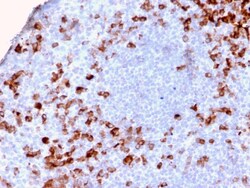
Biotium Human Kappa Light Chain / IGKC (B-Cell Marker)(KLC2886R), 0.2mg/mL
This MAb is specific to kappa light chain of immunoglobulin and shows no cross-reaction with lambda light chain or any of the five heavy chains. It recognizes human Ig kappa light chains of both secreted and cell surface immunoglobulin. It detects also free kappa light chains. In mammals, the two light chains in an antibody are always identical, with only one type of light chain, kappa or lambda. The ratio of Kappa to Lambda is 70:30. However, with the occurrence of multiple myeloma or other B-cell malignancies this ratio is disturbed. Antibody to the kappa light chain is reportedly useful in the identification of leukemias, plasmacytomas, and certain non-Hodgkin's lymphomas. Demonstration of clonality in lymphoid infiltrates indicates that the infiltrate is malignant. Primary antibodies are available purified, or with a selection of fluorescent CF Dyes and other labels. CF Dyes offer exceptional brightness and photostability. Note: Conjugates of blue fluorescent dyes like
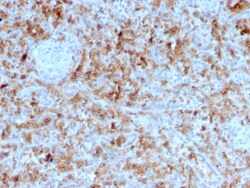
Biotium Granzyme B (NK/T-Cell Lymphoma Marker)(GZMB/3055), CF488A conjugate, 0.1mg/mL
Granzyme B is a member of the granule serine protease family stored specifically in NK cells or cytotoxic T cells. Cytolytic T lymphocytes (CTL) and natural killer (NK) cells share the ability to recognize, bind, and lyse specific target cells. They are thought to protect their host by lysing cells bearing on their surface 'nonself' antigens, usually peptides or proteins resulting from infection by intracellular pathogens. Granzyme B is crucial for the rapid induction of target cell apoptosis by CTLs in the cell-mediated immune response. Granzyme B is useful as a marker in the identification of NK/T-cell lymphomas. High percentages of cytotoxic T-cells have been shown to be an unfavorable prognostic indicator in Hodgkin's Disease. Primary antibodies are available purified, or with a selection of fluorescent CF Dyes and other labels. CF Dyes offer exceptional brightness and photostability. Note: Conjugates of blue fluorescent dyes like CF405S and CF405M are not recommende

ABclonal Technology Phospho-AKT2 specific-S474 Rabbit pAb

This gene is a putative oncogene encoding a protein belonging to a subfamily of serine/threonine kinases containing SH2-like (Src homology 2-like) domains, which is involved in signaling pathways. The gene serves as an oncogene in the tumorigenesis of cancer cells For example, its overexpression contributes to the malignant phenotype of a subset of human ductal pancreatic cancers. The encoded protein is a general protein kinase capable of phophorylating several known proteins, and has also been implicated in insulin signaling.

Sino Biological Human COMP Matched ELISA Antibody Pair Set 5 Plates
The Human COMP / TSP5 ELISA Pair Set is for the quantitative determination of Human COMP / TSP5.The Sino Biological ELISA Pair Set is a solid phase sandwich ELISA (Enzyme-Linked Immunosorbent Assay). It utilizes a monoclonal antibody specific for Human COMP / TSP5 coated on a 96-well plate. Standards and samples are added to the wells, and any Human COMP / TSP5 present binds to the immobilized antibody. The wells are washed and a horseradish peroxidase conjugated mouse anti-Human COMP / TSP5 monoclonal antibody is then added, producing an antibody-antigen-antibody "sandwich". The wells are again washed and TMB substrate solution is loaded, which produces color in proportion to the amount of Human COMP / TSP5 present in the sample. To end the enzyme reaction, the stop solution is added and absorbances of the microwell are read at 450 nm.
Sino Biological Cynomolgus CD200R Matched ELISA Antibody Pair Set 15 Plates
The Cynomolgus CD200R ELISA Pair Set is for the quantitative determination of Cynomolgus CD200R.This ELISA Pair Set contains the basic components required for the development of sandwich ELISAs.The Sino Biological ELISA Pair Set is a solid phase sandwich ELISA (Enzyme-Linked Immunosorbent Assay). It utilizes a monoclonal antibody specific for CD200R coated on a 96-well plate. Standards and samples are added to the wells, and any CD200R present binds to the immobilized antibody. The wells are washed and a horseradish peroxidase conjugated mouse anti-CD200R monoclonal antibody is then added, producing an antibody-antigen-antibody “sandwich”. The wells are again washed and TMB substrate solution is loaded, which produces color in proportion to the amount of CD200R present in the sample. To end the enzyme reaction, the stop solution is added and absorbances of the microwell are read at 450 nm.
Sino Biological Mouse PCSK9 Matched ELISA Antibody Pair Set 5 Plates
The Mouse PCSK9 ELISA Pair Set is for the quantitative determination of Mouse PCSK9.This ELISA Pair Set contains the basic components required for the development of sandwich ELISAs.The Sino Biological ELISA Pair Set is a solid phase sandwich ELISA (Enzyme-Linked Immunosorbent Assay). It utilizes a monoclonal antibody specific for PCSK9 coated on a 96-well plate. Standards and samples are added to the wells, and any PCSK9 present binds to the immobilized antibody. The wells are washed and a horseradish peroxidase conjugated rabbit anti-PCSK9 polyclonal antibody is then added, producing an antibody-antigen-antibody “sandwich”. The wells are again washed and TMB substrate solution is loaded, which produces color in proportion to the amount of PCSK9 present in the sample. To end the enzyme reaction, the stop solution is added and absorbances of the microwell are read at 450 nm.
Sino Biological Human MCP-1/CCL2 Matched ELISA Antibody Pair Set 15 Plates
The Human MCP-1 / CCL2 ELISA Pair Set is for the quantitative determination of Human MCP-1 / CCL2.The Sino Biological ELISA Pair Set is a solid phase sandwich ELISA (Enzyme-Linked Immunosorbent Assay). It utilizes a monoclonal antibody specific for Human MCP-1 / CCL2 coated on a 96-well plate. Standards and samples are added to the wells, and any Human MCP-1 / CCL2 present binds to the immobilized antibody. The wells are washed and a horseradish peroxidase conjugated rabbit anti-Human MCP-1 / CCL2 monoclonal antibody is then added, producing an antibody-antigen-antibody "sandwich". The wells are again washed and TMB substrate solution is loaded, which produces color in proportion to the amount of Human MCP-1 / CCL2 present in the sample. To end the enzyme reaction, the stop solution is added and absorbances of the microwell are read at 450 nm.
Sino Biological Mouse THSD1 Matched ELISA Antibody Pair Set 5 Plates
The Mouse THSD1 / TMTSP ELISA Pair Set is for the quantitative determination of Mouse THSD1 / TMTSP. This ELISA Pair Set contains the basic components required for the development of sandwich ELISAs.The Sino Biological ELISA Pair Set is a solid phase sandwich ELISA (Enzyme-Linked Immunosorbent Assay). It utilizes a monoclonal antibody specific for THSD1 / TMTSP coated on a 96-well plate. Standards and samples are added to the wells, and any THSD1 / TMTSP present binds to the immobilized antibody. The wells are washed and a horseradish peroxidase conjugated rabbit anti-THSD1 / TMTSP polyclonal antibody is then added, producing an antibody-antigen-antibody "sandwich". The wells are again washed and TMB substrate solution is loaded, which produces color in proportion to the amount of THSD1 / TMTSP present in the sample. To end the enzyme reaction, the stop solution is added and absorbances of the microwell are read at 450 nm.
Sino Biological Human CEACAM-5/CD66e Matched ELISA Antibody Pair Set 15 Plates
The Human CEACAM5 / CD66e ELISA Pair Set is for the quantitative determination of Human CEACAM5 / CD66e.The Sino Biological ELISA Pair Set is a solid phase sandwich ELISA (Enzyme-Linked Immunosorbent Assay). It utilizes a monoclonal antibody specific for Human CEACAM5 / CD66e coated on a 96-well plate. Standards and samples are added to the wells, and any Human CEACAM5 / CD66e present binds to the immobilized antibody. The wells are washed and a horseradish peroxidase conjugated mouse anti-Human CEACAM5 / CD66e monoclonal antibody is then added, producing an antibody-antigen-antibody "sandwich". The wells are again washed and TMB substrate solution is loaded, which produces color in proportion to the amount of Human CEACAM5 / CD66e present in the sample. To end the enzyme reaction, the stop solution is added and absorbances of the microwell are read at 450 nm.
Sino Biological Anti-IL6R (Research Grade Tocilizumab Biosimilar) 25 mg
This product is a recombinant monoclonal antibody expressed from HEK293 cells.
Sino Biological Human IL-13 R alpha 1/IL13RA1 Matched ELISA Antibody Pair Set 15 Plates
The human IL13RA1 / CD213a1 ELISA Pair Set is for the quantitative determinationof human IL13RA1.This ELISA Pair Set contains the basic components required for the development of sandwich ELISAs.The Sino Biological ELISA Pair Set is a solid phase sandwich ELISA (Enzyme-Linked Immunosorbent Assay). It utilizes a monoclonal antibody specific for IL13RA1 /CD213a1 coated on a 96-well plate. Standards and samples are added to thewells, and any IL13RA1 / CD213a1 present binds to the immobilized antibody. Thewells are washed and a horseradish peroxidase conjugated mouse anti-IL13RA1monoclonal antibody is then added, producing an antibody-antigen-antibody"sandwich". The wells are again washed and TMB substrate solution is loaded,which produces color in proportion to the amount of IL13RA1 present in thesample. To end the enzyme reaction, the stop solution is added and absorbancesof the microwell are read at 450 nm.